




Business Spend Management (BSM) is crucial for organizations looking to enhance operational efficiency and financial performance. By prioritizing BSM, organizations can achieve visibility into their financial outflows, enabling them to identify inefficiencies, reduce costs, improve supplier relationships, and allocate resources more strategically.
This comprehensive approach not only ensures financial health and operational efficiency but also fosters innovation and resilience by aligning spending with business objectives and market demands. As such, BSM is not merely a function of the finance department but a strategic component integral to overall business success.
In this post, we’ll take a deep dive into business spend management, including the benefits, challenges and steps to implement BSM. We’ll also take a look at how Source-to-Pay solutions can facilitate a successful BSM program in your organization.
Key Takeaways
- Business Spend Management is a framework that drives visibility, compliance, and smarter resource allocation across procurement, finance, and operations.
- Organizations that unify sourcing, procurement, invoicing, and spend analytics see higher efficiency, fewer errors, and better supplier performance.
- Mapping current processes, identifying inefficiencies, and automating workflows are essential first steps toward realizing the full ROI of BSM.
Why Business Spend Management is Important
BSM brings about a holistic approach to managing all aspects of organizational spending, leading to better financial performance, enhanced operational capabilities and a stronger foundation for strategic growth.
Ardent Partners found that best-in-class organizations have 77% of their spend under management, compared to just 56% for all others, leading to better budget adherence and cost control.
Key benefits of business spend management include:
- Cost Control: BSM helps organizations identify and eliminate maverick spending, negotiate better terms with suppliers and consolidate purchases to achieve bulk discounts.
- Increased Visibility and Transparency: By centralizing spend data, BSM provides clear insights into where and how money is being spent, allowing for more informed decision-making and strategic financial planning.
- Risk Mitigation: Effective BSM practices enhance compliance with regulatory requirements and internal policies, reducing the risk of financial penalties, fraud and reputational damage.
- Operational Efficiency: Streamlining procurement and expense processes through BSM tools reduces administrative burdens, freeing up resources for more value-added activities.
- Strategic Decision-making: With comprehensive spend analysis, organizations can make strategic decisions about supplier relationships, investment opportunities and cost-saving initiatives.
- Enhanced Supplier Management: BSM fosters better relationships with suppliers through efficient procurement processes, timely payments and effective communication, leading to improved service levels and potential for innovation.
What is Business Spend Management (BSM)?
Business Spend Management (BSM) refers to the processes, practices and tools organizations use to manage, control and optimize spending. BSM covers a wide range of activities, including supplier management, Sourcing, contract management, procurement, invoicing, expense management, and spend and financial analysis, aiming to increase efficiency, reduce costs and improve the bottom line while ensuring compliance and mitigating risk across all spending activities.
How Business Spend Management Evolved
BSM evolved from traditional procurement and accounting processes into a strategic organizational discipline through advances in integrated software, data analytics, and automation. Early spend controls were manual and siloed; today, modern BSM platforms combine procurement, finance, and analytics, enabling real-time insight and strategic decision-making based on enterprise-wide spend data.
How BSM Works – The BSM Process
A typical business spend management workflow follows these core stages:
- Planning: Establishing budgets and sourcing strategies based on historical spend data and organizational goals.
- Procurement: Executing sourcing, purchasing, contract negotiation, and supplier onboarding.
- Execution & Compliance: Enforcing purchasing policies, ensuring compliance, and routing orders through approved channels.
- Invoicing & Payment: Processing invoices, matching against purchase orders, and ensuring timely and accurate payments.
- Analysis & Optimization: Continuous spend analysis using data insights to identify procurement cost savings opportunities and improve process performance.
Expense Management vs. Business Spend Management
Expense Management and Business Spend Management are related yet distinct aspects of financial oversight within organizations, each focusing on different areas of spending. Below, we explain the main differences between Expense Management and Business Spend Management
| Aspect | Expense Management | Business Spend Management (BSM) |
| Scope | Employee expenses (T&E, reimbursements) | All organizational spend (procurement, contracts, indirect, direct) |
| Focus | Compliance with internal travel/expense policy | Enterprise-wide spend optimization and strategic alignment |
| Systems | Often standalone tools | Integrated Source-to-Pay and analytics platforms |
| Visibility | Limited to employee expenses | Broad visibility across suppliers, contracts, and budgets |
| Objective | Streamline reimbursements | Reduce costs, increase control and compliance |
How Spend Management is Integrated with Other Procurement Processes
BSM encompasses a wide range of procurement activities, including sourcing, purchasing, contract management and supplier relationship management. By integrating these processes, spend management provides a unified platform where data from various procurement activities is centralized, offering a comprehensive view of organizational spending, facilitating seamless workflows and ensuring that procurement activities are aligned with the organization’s financial goals and policies.
BSM’s integration extends to financial systems such as accounts payable and general ledger, ensuring that procurement decisions are reflected accurately in the organization’s financial records. This harmonization between procurement and finance allows for real-time budget tracking, improved financial forecasting and enhanced compliance with internal and external financial regulations.
Types of Business Spend
Before managing how your company spends, it is essential to understand what you are spending on. Business spend generally falls into the following categories:
- Direct Spend: Expenditures tied directly to production or delivery of goods and services.
- Indirect Spend: Operational costs not tied to production, such as IT, facilities, marketing, and professional services.
- Travel & Entertainment (T&E): Employee-incurred business travel and client entertainment expenses.
- Operational & Capital Expenditures: Recurring operational costs and long-term investments in assets or infrastructure.
Understanding these categories enables targeted strategies to control and optimize each area of expenditure.
Business Spend Management (BSM) is crucial for organizations aiming to enhance operational efficiency and financial performance. According to recent industry benchmarks, procurement teams now manage an average of about 71 % of total enterprise spend, up from roughly 66 % in prior years, with potential savings of 6 %–12 % on every new dollar of spend placed under procurement control.
This comprehensive approach not only improves financial health and operational efficiency but also fosters strategic decision-making by aligning spending with business goals. BSM is thus integral not only to finance teams but to broader organizational success.
Key Areas of Business Spend Management
Business spend management encompasses several key categories that work together to optimize and control an organization’s expenditures:
Supplier Management
Supplier management ensures that all supplier relationships are governed consistently across sourcing, procurement, invoicing, and payment. In a BSM context, supplier management directly links supplier performance to actual spend behavior.
Strategic Sourcing
Strategic sourcing is a core BSM discipline that aligns sourcing decisions with enterprise-wide spend visibility and long-term cost optimization. Rather than focusing on isolated sourcing events, BSM-driven strategic sourcing uses historical spend data, demand patterns, and supplier performance insights to inform category strategies.
Contract Management
Contract management bridges the gap between negotiated agreements and actual spend execution. Centralized contract repositories enable organizations to link contracts directly to purchase orders, invoices, and supplier records. This connection reduces value leakage by ensuring that pricing, terms, and service levels are consistently applied. Automated alerts for renewals, expirations, and compliance obligations further strengthen financial and legal control. As part of a BSM framework, contract management transforms procurement contracts from static documents into active spend control mechanisms.
Procure-to-Pay Process (P2P)
An end-to-end workflow that starts with requisitioning goods and services and ends with making payments to suppliers, encompassing procurement, receiving, invoicing and payment stages. P2P is primarily made up of:
- Procurement: The process of d buying goods and services that are essential for the organization’s operations.
- Invoicing: The processing and payment of invoices received from suppliers, including verifying the accuracy of invoices, ensuring that the goods or services billed were received and meeting the agreed-upon terms and managing timely payments.
Expense Management
Expense management represents a controlled subset of Business Spend Management focused on employee-initiated spend. Within BSM, expense data is integrated with procurement and financial systems to provide a complete picture of enterprise spend.
This integration helps identify policy gaps, off-contract purchases, and opportunities to shift recurring expenses to preferred suppliers or procurement channels. Automated expense controls reduce manual effort while improving compliance and reimbursement accuracy.
When managed as part of BSM, expenses are no longer isolated transactions but part of an enterprise-wide spend strategy.
Supply Chain Management
Supply chain management supports Business Spend Management by linking sourcing and procurement decisions with supply continuity, logistics costs, and inventory performance. By integrating supply chain data into BSM, organizations gain greater visibility into upstream and downstream spend drivers, enabling more accurate cost control, risk mitigation, and strategic planning across the entire value chain.
Spend Analysis
Spend Analysis is the analytical foundation of Business Spend Management, enabling data-driven control and optimization of enterprise spend. It consolidates transactional data from procurement, invoicing, expenses, and ERP systems into standardized spend classifications.
Accurate spend analysis allows organizations to identify unmanaged spend and savings opportunities across categories. It also supports performance tracking against sourcing strategies and compliance objectives. Without robust spend analysis, BSM initiatives lack the visibility required to drive continuous improvement and measurable ROI.
Who is Responsible For Business Spend Management?
BSM is for more than just procurement teams; it plays a critical role across various executive functions within an organization. For example, McKinsey found that companies that digitize their supply chains can expect to boost annual revenue growth by 2.3%.
For a successful BSM implementation, a critical best practice is to actively involve stakeholders from various departments, such as finance, procurement, IT and operations, right from the outset. Their input is invaluable in understanding the unique challenges and requirements of each department. Remember: stakeholders are more likely to support a system they’ve had a hand in shaping
For Chief Financial Officers (CFOs), BSM is pivotal in achieving financial clarity and control over the organization’s spend, directly influencing the bottom line. It enables more accurate forecasting, budgeting and financial reporting, helping CFOs to manage cash flow effectively, identify cost-saving opportunities, and ensure regulatory compliance and financial integrity.
The Chief Procurement Officer (CPO) relies on BSM to optimize procurement strategies, ensuring that the organization secures the best value from its supplier relationships. BSM provides insights into spending patterns, supplier performance and contract compliance, allowing CPOs to negotiate more favorable terms, mitigate supply chain risks and drive procurement efficiencies.
Chief Supply Chain Officers (CSCOs) gain a comprehensive view of the supply chain spend that helps to streamline operations. By integrating procurement data with supply chain management, CSCOs can improve supplier collaboration, reduce costs, enhance logistics and inventory management, and ensure the resilience and sustainability of the supply chain.
BSM helps align IT spending with business goals by providing Chief Information Officers (CIOs) the tools to manage IT procurement, license compliance and vendor performance. They can also use it to facilitate strategic IT sourcing, manage cybersecurity risk, and budget for digital transformation initiatives.
Challenges in Spend Management
Before businesses can capitalize on these opportunities, they must overcome many common challenges. From decentralized spend data, supplier management inefficiencies, poor spend visibility and lack of automation.
Implementing a spend management solution often requires significant changes in organizational processes, technologies and culture, as employees and management may resist adopting new systems and workflows.
BSM relies heavily on the quality and consistency of data across various systems, so inaccurate, incomplete or inconsistent data can undermine spend analysis and decision-making. Not only that – integrating disparate functions such as procurement, finance or HR to create a cohesive BSM framework can be technically challenging, requiring significant time and resources to ensure seamless data flow and interoperability.
Effective BSM requires strong relationships with suppliers, but managing these relationships can be complex. BSM functions like procurement, invoicing and expense management, which are not only time-consuming but also prone to error. To make matters worse, non-compliance with internal policies or external regulations can result in financial penalties and reputational damage.
Addressing these challenges requires a strategic approach to BSM that leverages spend analysis software to automate and integrate processes.
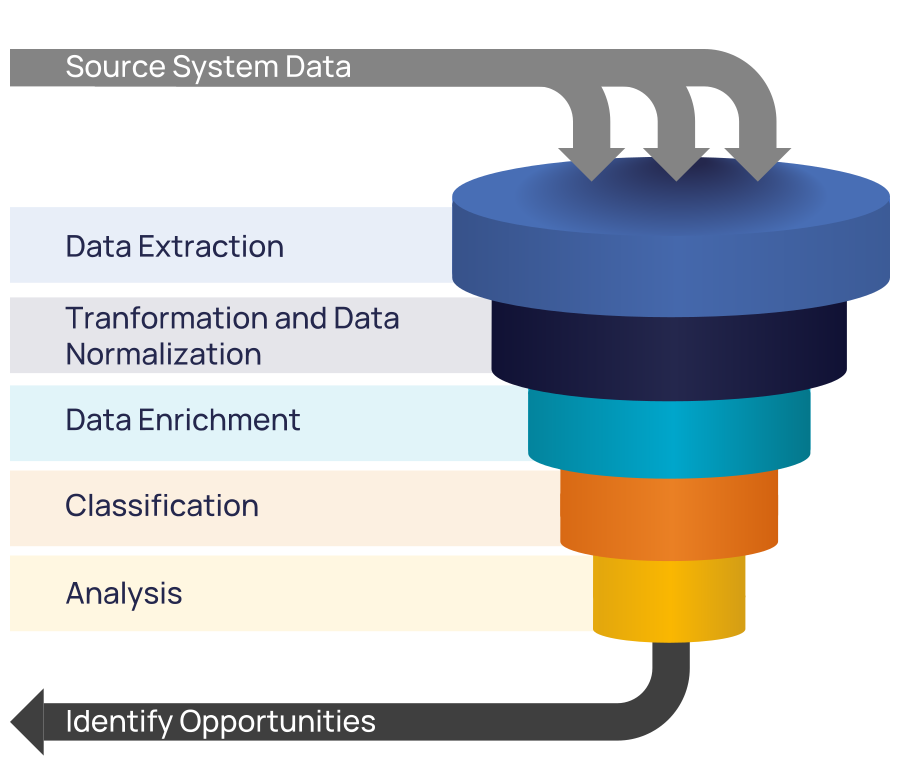
Steps for Implementing a Business Spend Management Strategy
Developing and executing a BSM strategy involves a structured approach. Here are the key steps in this process:
Step 1: Assess the Current State of Spending
Conduct a thorough analysis of existing spend management processes, including procurement, invoicing and expense management. Identify current spend across various categories and departments to understand where and how resources are being utilized, and evaluate existing challenges, such as inefficiencies, lack of visibility or compliance issues, to establish a baseline for improvement.
Step 2: Set Goals and Objectives
Define clear, measurable objectives for your BSM strategy and align BSM goals with broader organizational objectives to ensure support from stakeholders. Prioritize objectives based on their potential impact and feasibility.
Step 3: Choose the Right Spend Management Software
Be sure to research and evaluate and choose a BSM platform that meets your organization’s specific needs. Consider conducting demos or pilot tests with shortlisted vendors, and make a selection based on a comprehensive analysis of features, costs and potential ROI.
Step 4: Implement the Spend Management Solution
Develop a detailed implementation plan, including timelines, resource allocations and key milestones, and ensure proper integration with other mission critical systems. Make sure you provide comprehensive training for users to encourage adoption.
Step 5: Measure and Improve Performance
Establish key performance indicators (KPIs) related to enterprise spend management – savings achieved, procurement cycle times, compliance rates and supplier performance metrics – and regularly monitor and analyze performance against these them to identify areas for improvement.
Aligning the BSM strategy with overarching business goals is another critical practice. By ensuring that enterprise spend management objectives contribute directly to the company’s strategic priorities, organizations can secure executive support and ensure resources are allocated effectively.
Community data and industry benchmarks can help to inform and refine your BSM strategy. Comparing performance metrics, spending patterns and process efficiencies against industry standards helps identify gaps and opportunities for improvement.
Regularly reviewing and updating BSM processes and practices in response to changing business needs, technological advancements and lessons learned can further enhance the effectiveness and sustainability of your BSM strategy.
Spend Management Software: How to Choose the Right Solution
Choosing the right spend management software for business spend management is a critical decision that requires careful consideration of several key factors to ensure the solution aligns with your organization’s needs and objectives. Questions to ask during the vendor evaluation process include:
- How does your solution integrate with our existing ERP and other enterprise systems?
- How can the software be tailored to our specific business processes and workflows?
- What data security measures and compliance standards do you adhere to?
- What is the typical implementation timeline? What resources are required from our side?
- How scalable is your spend management solution?
- What training and support services do you offer?
- How do you handle software updates and upgrades?
- Can you provide references from other clients?
- What is the total cost of ownership, including setup fees, subscriptions and potential additional charges for extra features or services?
- How does your solution support mobile access and remote work capabilities?
- What analytics and reporting capabilities does your software provide?
Asking these questions will provide a deeper understanding of the spent management software’s capabilities, how it aligns with your needs and what to expect in terms of implementation, support and costs. Use Ivalua’s Spend Analysis Data Sheet to understand your spend and uncover opportunities to manage spend with Spend Analysis software.
BSM Software Features to Look For:
When evaluating BSM tools, assess the following capabilities:
- Unified source-to-pay workflow support with PO, invoice, and payment controls.
- Real-time dashboards with spend categorization and analytics.
- Automated policy enforcement and guided buying experiences.
- Supplier portal with performance tracking and risk indicators.
- Seamless integration with ERP, AP, and financial systems.
How to Automate Business Spend Management With Ivalua
Ivalua’s Source-to-Pay software is designed to automate and streamline procurement and enterprise spend management processes across an organization. The software provides a comprehensive suite of tools to manage the entire spend lifecycle, from sourcing and procurement to invoice management and spend analysis.
By integrating various aspects of spend management – including procurement, sourcing, contract management, analytics, and tail spend management – Ivalua transforms complex, manual processes into efficient, automated workflows.
This automation not only accelerates operations but also reduces the likelihood of errors, ensuring compliance and enhancing operational efficiency, while also providing real-time visibility into spending and supplier performance.
Ivalua’s advanced analytics capabilities offer deep insights into spending patterns, as well, enabling businesses to identify cost-saving opportunities and make informed strategic decisions. This comprehensive approach enables organizations to control costs more effectively, mitigate risks and, ultimately, drive better business outcomes.
Agentic AI further enhances Business Spend Management by acting proactively across procurement and spend workflows rather than only reacting to user input. AI agents in procurement can autonomously monitor spend patterns, flag non-compliant or high-risk transactions, recommend preferred suppliers, and initiate corrective actions such as re-routing purchases or launching sourcing events.
Embedded AI assistants like IVA also support procurement and finance teams by answering spend-related questions, generating insights on demand, and guiding users through compliant purchasing processes, improving both efficiency and decision quality.
Learn how to transform your Procurement strategy and operations with the power of artificial intelligence.
A recent study paints a compelling picture of the value customers can expect to achieve from Ivalua’s platform:
- Reductions in procurement overhead, coupled with increased spend visibility, innovation opportunities, and streamlined supplier engagement.
- 393% Return on Investment (ROI) achieved through process automation, cost reduction, visibility improvements, and legacy system consolidation.
- $25.5M Net Present Value (NPV) generated over three years for the composite organization studied.
- Non quantified benefits including improved ESG performance, risk, compliance and overall visibility with a single source of truth from Ivalua’s “Golden Supplier Record.”
Successful Business Spend Management Implementation
CACI provides information solutions and services in support of national security missions and government transformation for Intelligence, Defense, and Federal Civilian customers. The organization was looking to improve efficiency and empower Procurement and AP to analyze, not re-enter data.
They wanted to streamline procurement and accounting processes and enable full visibility throughout the procurement process.
However, separate systems for PR, PO, Invoicing and Payment was forcing users to log in to multiple systems andre-enter data, and the ERP system did not meet Procurement or stakeholder needs.
After implementing Ivalua, they went virtually 100% paperless and addressed 95% of spend through sourcing process and formal agreements. They also cut costs by 30%. Read the full case study.
“With the right team and the right technology, true digital transformation is possible. Ivalua’s platform empowered us to realize virtually 100% paperless procurement and account payable processes. The ease of use and supplier friendly model delivered rapid value, and the flexibility helped bring our talent’s best ideas to life to build a competitive advantage.” – William Mertz, Procurement at CACI
Manage Spend the Right Way With Ivalua
Prioritizing Business Spend Management is essential for optimizing operational efficiency and achieving cost savings, which are vital for business success. It enhances spending visibility, improves financial controls, and fosters strong supplier relationships, making organizations more agile and resilient.
Ivalua’s Source-to-Pay platform supports these goals by automating procurement processes, offering real-time spend analytics and facilitating strategic supplier management.
With Ivalua, businesses can streamline their spend management practices, enabling better decision-making and fostering long-term growth.
Power Enterprise Efficiency With Ivalua
Business Spend Management FAQs
Business Spend Management (BSM) refers to the processes, tools, and strategies used to control, optimize, and gain visibility into all organizational spending. It covers everything from procurement and supplier management to invoicing, expense tracking, and analytics.
Expense management focuses specifically on tracking and reimbursing employee-related spending, such as travel or office supplies. Spend management takes a broader view, covering all types of business expenditures across procurement, contracts, suppliers, and operations.
Key categories include supplier management, strategic sourcing, contract management, procurement (or procure-to-pay), expense management, supply chain management, and spend analysis. Together, these areas help organizations manage spend strategically and at scale.
A strong BSM strategy includes process standardization, integrated technology platforms, real-time spend visibility, cross-functional collaboration, and performance tracking through KPIs. These elements align spending with business goals and improve financial decision-making.
BSM reduces costs by identifying inefficient spending, consolidating purchases, enforcing contract compliance, and improving supplier negotiations. Automation and data visibility also eliminate manual errors and uncover new savings opportunities.